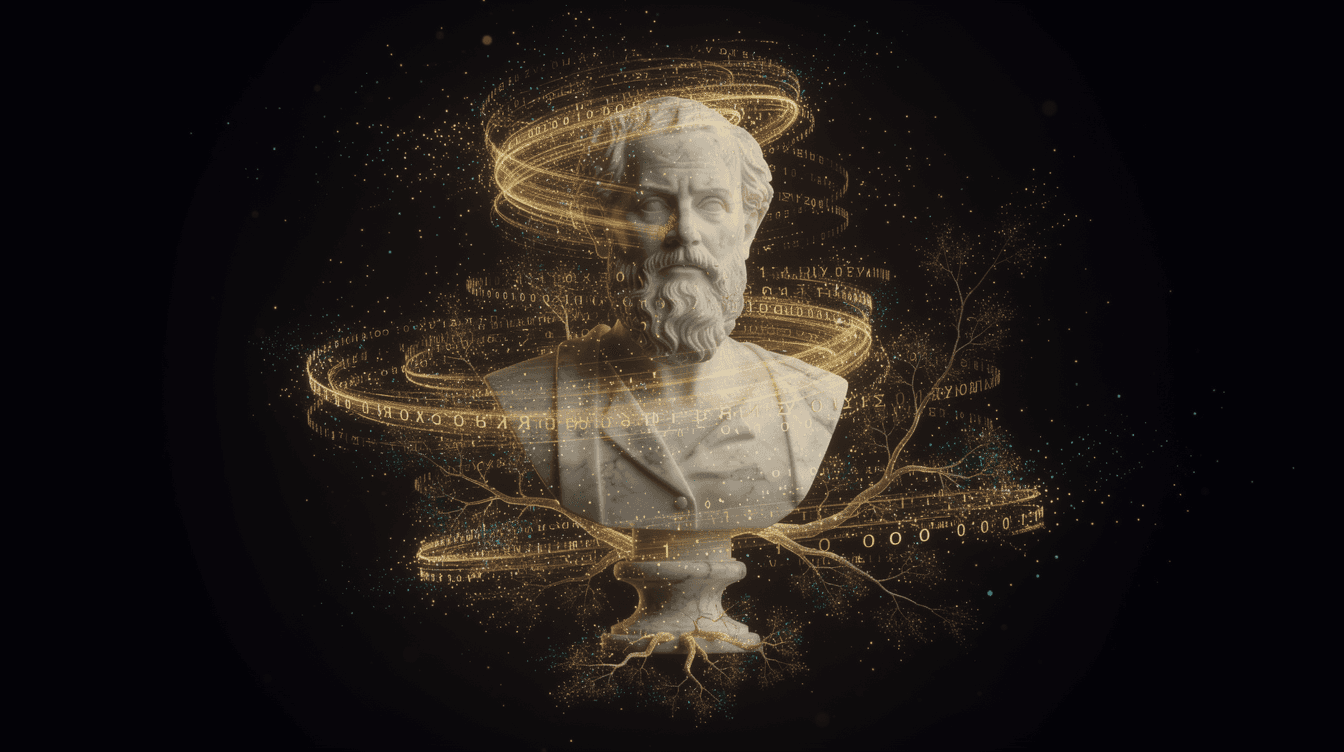
Your AI Answers Are Shallow — and It’s Your Fault
You think the problem is the model.
It’s not.
You’re feeding it hollow prompts and expecting wisdom.
That’s like asking a library for the meaning of life and getting the Dewey Decimal number for existentialism.
The real breakthrough won’t come from bigger parameters or faster chips.
It will come from priming artificial intelligence with philosophy — the most rigorous toolkit humanity ever built for questioning, reasoning, and uncovering depth.
Most users treat AI like a search engine with manners.
They miss the fact that large language models are mirrors: they reflect the structure of thought you hand them.
Pour in a flat, utilitarian query, and you get a flat, utilitarian answer.
But lace that same query with Socratic doubt, an ethical lens, or a fragment of phenomenological inquiry, and the machine pivots.
It starts generating responses that don’t just answer — they unfold.
This is not speculation.
Researchers and prompt engineers are already seeing that grounding an AI’s context in philosophical frameworks produces outputs with more nuance, better moral reasoning, and a far deeper grasp of human intent.
The difference is as stark as a conversation with a call-center script versus a dialogue with a trained therapist.
The tool hasn’t changed.
You have.
The Shallow Depths of Unprimed AI
A raw language model is an echo of its training data.
That data is the internet — a vast, brilliant, and deeply shallow ocean.
Without careful priming, the AI defaults to the statistical center of that ocean, where nuance sinks and clichés float.
You’ve seen the results: safe, agreeable paragraphs that say nothing at all.
Even the technical architects of modern intelligence warned against this.
Foundational texts like Deep Learning by Goodfellow, Bengio, and Courville don’t just teach backpropagation.
They reveal that a network’s output is entirely dependent on the objective function — the philosophical north star you give it.
When that north star is “predict the next token,” you get a brilliant mimic.
When you add a layer of philosophical intent, you get a reasoning engine.
The public discourse obsesses over ai detector tools and fears of cheating.
That misses the point.
The crisis isn’t that machines can write — it’s that we’re teaching them to write without thinking, and judging them on coherence rather than insight.

Why Philosophy Matters for Machines That Think
Philosophy is not decoration for an AI prompt.
It is a functional architecture for thought.
When you ask an AI to analyze a moral dilemma without a framework, it flattens the problem into a popularity contest of Reddit opinions.
Prime it with the ethics of care, and the response shifts dramatically.
The model suddenly weighs relationships, vulnerability, and responsibility — not just rules or outcomes.
This is not metaphor.
The structure of philosophical reasoning maps perfectly onto the latent space of a neural network.
A well-phrased Kantian categorical imperative gives the model a rigid decision boundary.
A utilitarian frame forces it to calculate wide consequences.
An existentialist prompt unlocks explorations of authenticity and choice.
Each framework is a lens that bends the model’s probability distribution toward deeper meaning.
It’s the difference between asking “Is this action right?” and “What would a wise person, who has absorbed Simone de Beauvoir’s ethics of ambiguity, see that I’m missing?”
The AI, suddenly, sees a lot.
Priming with Ethical Frameworks: From Kant to Care
The most transformative use of philosophical priming is in artificial intelligence in medicine.
A diagnostic AI asked to recommend a treatment can churn out a statistical best-fit.
An AI primed with the ethics of care pauses.
It asks not just “What works?” but “What preserves the patient’s dignity? What honors their relational world? Who is caring for whom?”
These prompts don’t require the model to have feelings.
They require the model to navigate a structured value space, and that structure comes directly from the human philosophical canon.
The same shift applies to an ai agent negotiating a conflict.
Without priming, it seeks an efficient compromise.
With a dose of Rawlsian justice, it hunts for the arrangement that protects the least advantaged stakeholder.
This is practical magic.
And it is open to anyone who has read deeply — or even skimmed the right philosophy books.
You don’t need a PhD.
You need the willingness to treat your prompt as a philosophical act.
Building a Philosophical AI Agent
A truly powerful AI agent is not the one with the most tools.
It is the one with the richest interpretative layer.
Integrating philosophical priming into agentic workflows turns a task-doer into a meaning-maker.
Consider an agent handling customer service for a brand like Airbnb.
A vanilla bot solves the surface issue: refund, rebook, apologize.
An agent primed with the philosophy of hospitality — the ancient duty of a host to a stranger — crafts a response that heals trust, not just transactions.
It recognizes that a broken boiler is, for a tired traveler, a small exile from comfort, and it speaks to that exile.
This is not sentimentality coded into a script.
It is the emergent property of a machine navigating a conceptual space seeded with human depth.
The same principle holds for a legal AI, a writing assistant, or a tutor.
In each case, the philosophical primer acts as a governor on shallowness.
It refuses to let the model default to the mean.
It demands, gently and persistently, that the machine reach toward the profound.
Deep Learning’s Debt to Deeper Thought
There is a quiet irony in the world of AI.
The engineers building the most advanced systems often reach for philosophy without saying its name.
François Chollet, in Deep Learning with Python, argues that the essential skill in AI is abstraction — the ability to map the messy world into clean conceptual spaces.
That is, quite literally, the craft of the philosopher.
The deep learning community already speaks of “representations” and “ontologies.”
They are borrowing tools from Aristotle and Kant whether they know it or not.
By making this debt explicit, we unlock better machines and sharper developers.
The next frontier for an ai agent is not a bigger context window.
It is a conscience — not in the sense of sentience, but in the sense of a consistently applied ethical and conceptual framework.
Philosophy provides the blueprints.
Every prompt is a chance to use them.
Stop Prompting Like a Manager.
Start Thinking Like a Philosopher.
The argument is simple and uncomfortable.
If your AI gives you dull, shallow, or morally tone-deaf answers, don’t blame the lab that trained it.
Blame the poverty of your own philosophical input.
The tools are not broken.
They are waiting for better questions.
The future of artificial intelligence is not just technical — it is fundamentally humanistic.
It belongs to the developers who have read Artificial Intelligence: A Modern Approach but also wrestled with the ethics of care.
It belongs to the prompters who can see a query not as a command, but as an invitation to think more clearly.
The machine will race ahead.
Your only chance to steer it, to deepen it, to make it wise rather than merely fast, is to embed within it the one thing it cannot generate from statistical noise: the raw, demanding, beautiful structure of philosophical thought.
Prime it.